
Compost Machine
A compost machine converts food and garden waste into compost at the place it is generated. It shreds the waste, mixes it with a composting culture and holds it at a controlled temperature with steady aeration through an automated processing cycle of about 24 hours. The discharged stabilised material then needs a separate curing period before it is used as finished compost.
- 24 hrsMachine cycle
- 10–15 daysCuring after
- 10 Kg – 5 TPDCapacity range
- From ₹75,000Price in India

























What do you run?
Most buyers do not know their daily waste in kilograms yet — but everyone knows what they operate. Pick yours and we will show the machine that fits, and the one thing that usually decides the purchase for you.
—
—
Not on this list, or handling more than one stream? Tell us what you generate — we size it against your actual numbers.
Just tell us your daily waste
One number is enough to start. Send your daily wet waste in kilograms and we will come back with the right machine and a written price within 24 working hours.
- Written quotation within 24 working hours
- Direct from the manufacturer, no dealer margin
- We will tell you if you are over-buying
Compost machines from 10 Kg/day to 5 TPD
Start with your measured daily wet waste. The cards below show the range; power, footprint and full specifications stay on the dedicated models page.
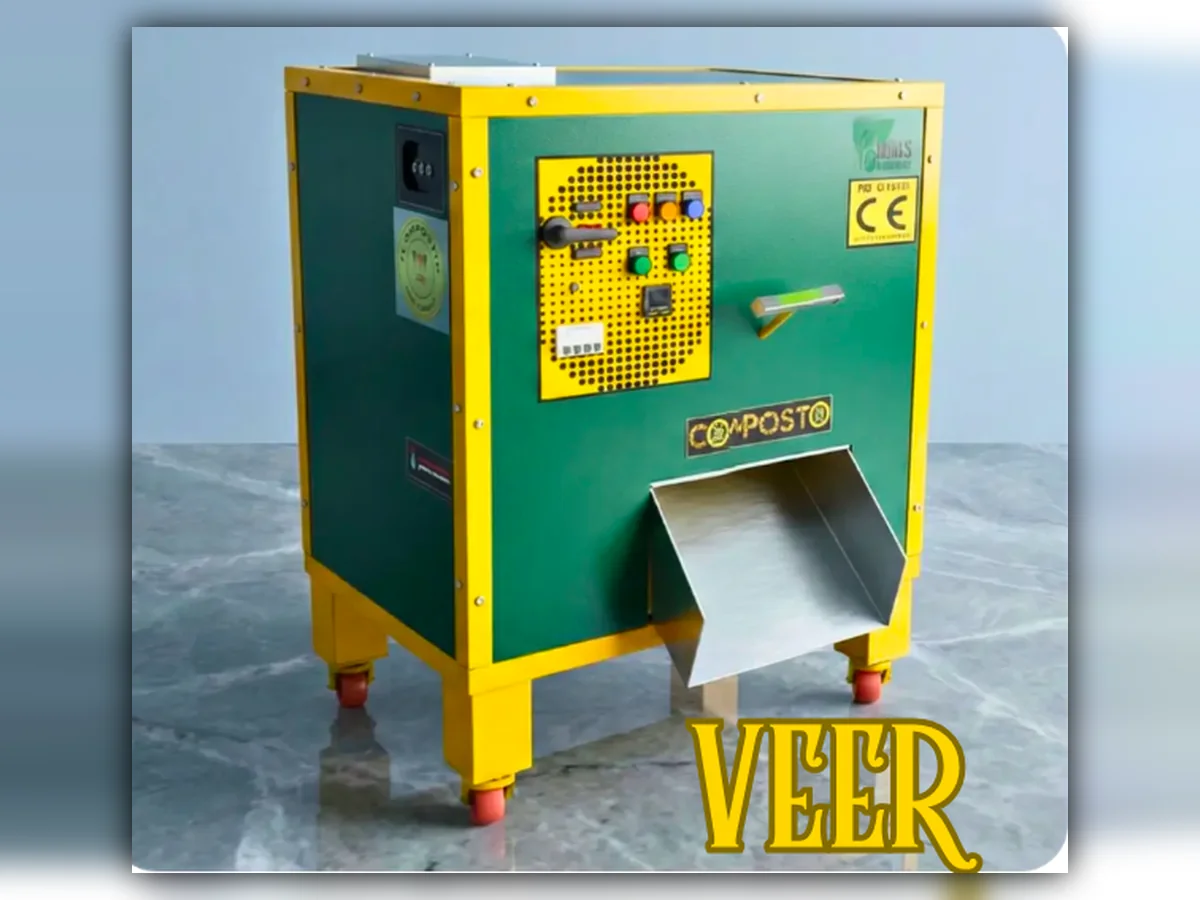
COMPOSTO VEER
Small premises
COMPOSTO 2.0
Small societies & kitchens
OWC 50 SS
Housing societies
OWC 100 SS
Hotels & campuses
OWC 200 SS
Large hotels & malls
OWC 500 Industrial
Townships & large institutions
Turnkey Plant
Large projects
How a compost machine works
Four stages, one cycle. The illustrated flow below follows a single batch of waste through the machine — tap any stage to read what is actually happening inside it.
Correct source segregation is essential. Food scraps, fruit and vegetable waste, eggshells and suitable garden organics can be processed; hard contaminants and non-organic material can damage the shredder and must stay out.
See a compost machine in action
A quick visual look at the machine and the organic-waste processing workflow.
Types of composting compared
A compost machine is one of five ways to compost organic waste, and it is not always the right one. Here is the honest comparison — including where the cheaper methods win.
| Method | Time to compost | Space needed | Labour | Odour & pests | Best suited to | Cost pattern |
|---|---|---|---|---|---|---|
| Automatic compost machine In-vessel / OWC | 24 hours + curing | 12–160 sq ft | Minimal — load and unload | Closed system, low-odour when correctly operated | Societies, hotels, campuses, municipal bodies | Capital cost, low running cost |
| Windrow composting Open row turning | 8–16 weeks | Very large, open land | High — mechanical turning needed | Open to air, odour and pests likely | Rural land, agricultural scale | Low capital, high land and labour |
| Vermicomposting Worm beds | 6–12 weeks | Moderate, shaded beds | Moderate, plus worm care | Low if managed well | Gardens, schools, small institutions | Low capital, sensitive to climate |
| Pit or bin composting Traditional | 3–6 months | Small but needs several bins | Manual turning | Often anaerobic and smelly | Individual homes, small gardens | Almost none |
| Rotating drum composter Tumbler | 4–8 weeks | Small | Manual rotation | Low | Homes, very small volumes | Low capital |
When a machine is not the right answer
If you have open land, patient timelines and agricultural volumes, windrow composting costs a fraction of a machine and works perfectly well. If you are a single household with a garden, a drum composter or a pit will do the job for almost nothing. The machine earns its cost where space is tight, timelines are short, odour is unacceptable, and the waste includes cooked food — which describes almost every apartment complex, hotel kitchen and institutional campus in an Indian city.
Who installs a compost machine
See real installations in each of these categories on the projects page — photographs and case studies from municipal, hotel, defence and temple sites.
What capacity do you need?
Estimate 0.3–0.5 Kg of wet waste per person per day, then pick a machine that runs at 60–80% of capacity on an ordinary day. A 60-flat society producing around 50 Kg needs a 50 Kg machine; a hotel producing 100 Kg needs a 100 Kg machine.
The machines page has all seven sizes side by side, with power load, footprint and an interactive floor-plan tool that shows the space each one takes.
Compare All ModelsWhat does it cost?
Compost machine price in India starts at ₹75,000 for a 10–25 Kg/day unit and rises to ₹9,50,000+ for a 500 Kg/day industrial machine. Between those, body material and automation move the number more than capacity does.
The price page breaks down exactly what drives the figure, what is included, and how the cost compares with paying a waste contractor over five years.
See the Price BreakdownSix checks before buying a compost machine
Most machines that end up parked and unused failed one of these checks at purchase, not in operation. Tap any one to open it.
Average three ordinary days. This one number decides capacity, price and whether you end up paying for capacity you never use.
Anything above 25 Kg/day needs three-phase supply. If your site has only single phase, that constrains the choice before anything else does.
Full SS 304, or MS with stainless contact parts? In wet, warm or coastal conditions this is what decides whether the machine lasts five years or fifteen.
Installation, commissioning and operator training should be inside the quotation, done by the manufacturer rather than handed to a local subcontractor.
Blades, belts and seals wear out — that is normal. What is not normal is waiting six weeks for a part. Get the service response commitment in writing.
Output needs 10–15 days in curing bins. Buyers who forget this end up with a working machine and nowhere to mature the compost.
Compost machine FAQs
A compost machine is an enclosed unit that processes source-segregated food and suitable garden waste where it is generated. It shreds and mixes the waste while controlled heat and aeration support aerobic decomposition through an automated cycle of roughly 24 hours. The discharged stabilised material then cures for about 10 to 15 days before use as finished compost.
In: all cooked and raw food waste, vegetable and fruit peel, bones, eggshells, tea and coffee grounds, garden trimmings, flowers and leaves. Out: plastic, glass, metal, cloth, ceramics, sanitary waste and large quantities of oil or liquid. Non-organic items do not decompose and will damage the shredder assembly.
When it is correctly loaded and maintained, the enclosed aerobic process is designed to keep odour low. Noticeable smell usually points to overloading, excess liquid, poor segregation or restricted airflow; those operating conditions should be corrected rather than treated as normal performance.
Published connected loads are approximately 2.0 kW for the 10–15 Kg/day VEER, 3.5 kW for the 25 Kg/day COMPOSTO 2.0, 4.5 kW for the 50 Kg/day model, 6.0 kW for the 100 Kg/day model, 8.5 kW for the 200 Kg/day model and 15.5 kW for the 500 Kg/day industrial model. Actual consumption varies with load, moisture and operating pattern.
With routine maintenance a well-built machine runs for well over a decade. The parts that wear are the shredder blades, the drive belts and the seals — all replaceable. Body material decides most of the lifespan: SS 304 resists the constant moisture and salts far better than painted mild steel, which is why we recommend it for coastal and high-humidity sites.
Daily: load it, remove the output, keep the feed area clean. Monthly: check the bio-filter and clear the air path. Periodically: inspect blades and belts for wear and top up composting culture. None of this is technical work — housekeeping or kitchen staff handle it after the training we give at commissioning. An AMC covers the mechanical servicing.
Yes, once it has been cured. Material coming straight out of the machine is stabilised but still active, and using it immediately can stress plants. After 10 to 15 days in curing bins it becomes mature, nutrient-rich compost suitable for gardens, landscaping, or bagging and sale. Most of our institutional clients use it on their own grounds.
It depends on what constrains you. Vermicomposting has almost no capital cost but needs weeks, shaded space, and worms that are sensitive to temperature swings and to cooked or oily food. A machine costs money upfront but processes in a day, accepts cooked food and bones, needs a fraction of the space, and does not stop working in summer. For an apartment complex or a hotel kitchen the machine is usually the only practical option.
Under the Solid Waste Management Rules, 2026, listed institutional, commercial and residential-society entities qualify as Bulk Waste Generators if they meet at least one national criterion: building floor area of 20,000 sq. m or above, water consumption of 40,000 litres/day, or solid waste generation of 100 Kg/day. The applicable local-body process and wet-waste processing arrangement should be checked for the specific property.
Estimate 0.3 to 0.5 Kg of wet waste per person per day, then choose a machine that runs at 60 to 80 per cent of its rated capacity on an ordinary day. Better still, weigh your wet waste bins for three normal days and average them — that single measurement is more reliable than any formula and is what stops buyers over-paying for capacity they never use.
Published prices start at ₹75,000 for the 10–15 Kg/day COMPOSTO VEER and ₹95,000 for the 25 Kg/day COMPOSTO 2.0. The 500 Kg/day industrial model starts at ₹9,50,000. Prices exclude GST. The 50, 100 and 200 Kg/day models are quoted on request.
It can be installed in an appropriate indoor service area when the site provides the required power, drainage, ventilation and service clearance. Final placement should be checked against the selected model, waste route and local site conditions rather than assuming every enclosed room is suitable.
Tell us your daily waste, we will tell you the machine
Send the weight in kilograms and the type of property. We will recommend the right capacity — including when a smaller machine will do the job.
Prefer a written enquiry form? Open contact page →