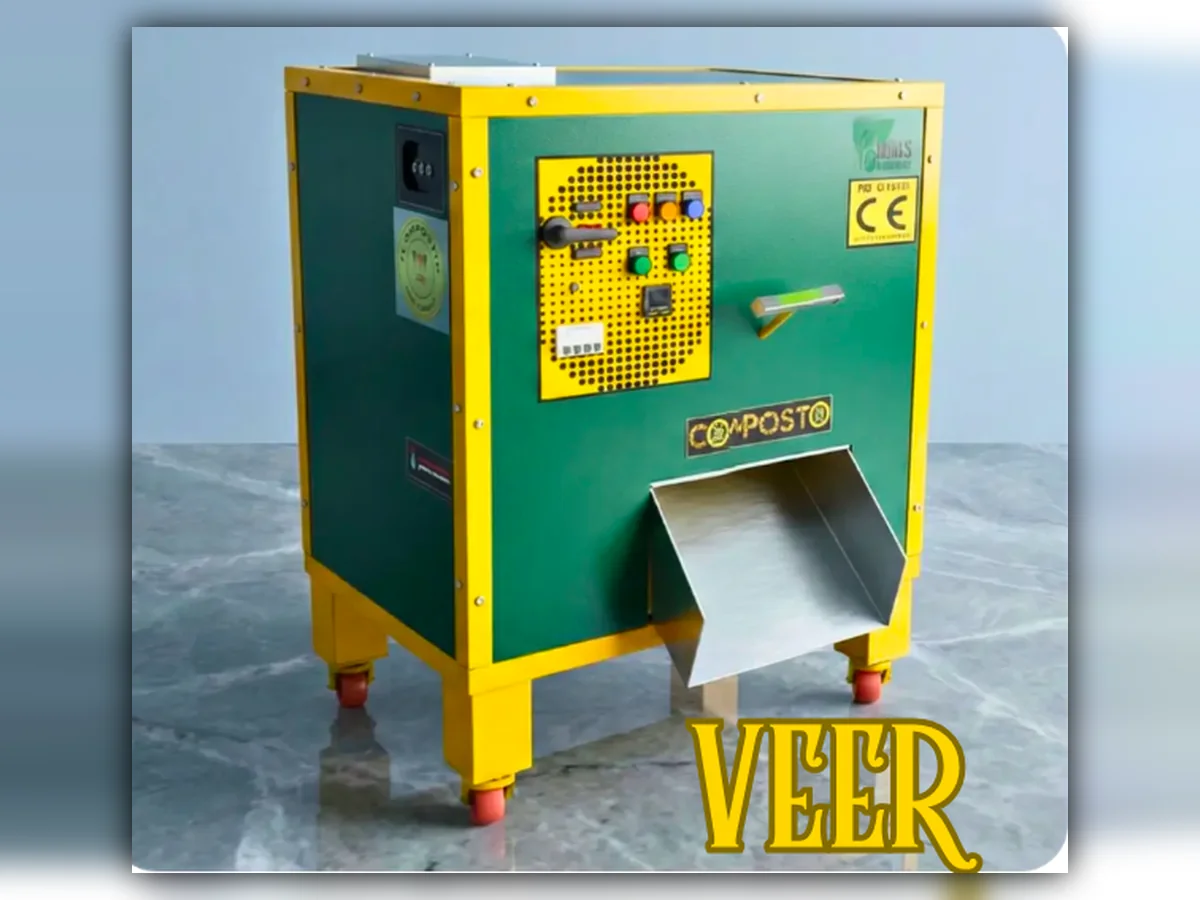
Composting Machine
A composting machine converts organic waste — kitchen food waste, garden trimmings, floral waste — into compost where it is generated. It shreds, mixes and holds the material at a controlled temperature with steady aeration, finishing in about 24 hours what an open pit takes months to do, at roughly 15% of the original volume.
- 24 hrsFull cycle
- ~85%Volume reduced
- 10 Kg – 5 TPDCapacity range
- From ₹75,000Price in India
What happens in 24 hours
Waste goes in, compost comes out — and almost nobody explains the middle. Drag the slider through a single batch and watch the temperature climb, the volume collapse and the material change.
Loading
—
—
The machine's job ends here. The output cures for a further 10–15 days in bins, which is what turns stabilised material into mature compost. Skipping curing is why some users complain their compost "burns" plants.
What can actually go in?
Tap any item. It sorts itself and tells you why — including the four things that will damage the machine, and the handful people get wrong most often.
Tap an item
In practice the yes-list is too long to put on a wall. Sites that get this right display the no-list instead — plastic, foil, cutlery, glass. Four items, and new staff can learn it on day one.
Which organic waste stream is yours?
Different streams behave differently inside the machine — kitchen waste is wet and dense, garden waste is dry and bulky, floral waste is fibrous. Pick yours and we will show the machine that fits it.
—
—
Tell us what you generate
Your daily organic waste in kilograms — or just the number of people, covers or flats you serve. That is enough for us to size the machine and send a written price within 24 working hours.
- Written quotation within 24 working hours
- Direct from the manufacturer, no dealer margin
- We will tell you if a smaller machine will do
Which machine fits?
Six models from 10 Kg to 5 TPD. Societies and restaurants usually land on the 50 or 100 Kg machines; townships and municipal bodies on the 500 Kg or a turnkey line.
Full specifications, power load, floor space and an interactive space planner that shows what each machine actually takes up.
Compare All ModelsWhat does it cost?
From ₹75,000 for a 10–25 Kg unit, up to ₹9,50,000+ for a 500 Kg industrial machine. Body material and site conditions move the number more than capacity alone does.
The price page breaks down exactly what drives the figure and compares it with paying a waste contractor over five years.
See the Price BreakdownComposting machine FAQs
A composting machine is an enclosed unit that converts organic waste into compost at the place it is generated. It shreds the waste, mixes it with a composting culture, and holds it at a controlled temperature with continuous aeration so aerobic microbes complete in about 24 hours what an open pit takes months to do. The output is then cured for 10 to 15 days to become finished compost.
In four stages inside a single cycle. Waste is loaded without any sorting; blades shred it to a uniform particle size while paddles mix in a composting culture; aerobic microbes then generate heat and the chamber holds 55 to 65°C with steady airflow; after roughly 24 hours the machine discharges a dark, stabilised, odour-free material at about 15 per cent of the volume that went in.
Cooked and raw food waste, vegetable and fruit peel, curry and gravy, tea and coffee grounds, eggshells, fish and meat scraps, garden trimmings, flowers and temple nirmalya, and expired food once unwrapped. What must stay out is plastic, glass, metal, foil, thermocol and cloth. Bulk cooking oil, large bones and coconut shells should be limited rather than banned.
Yes, and this is the main practical difference from pit composting or vermicomposting, where cooked, oily and salted food causes odour, pests and worm die-off. Spice and salt at normal kitchen concentrations are not a problem. The exception is bulk used frying oil, which coats the material, blocks airflow and stalls the cycle.
No, when it is running correctly. The process is aerobic and enclosed, with a bio-filter on the exhaust, and aerobic decomposition does not create the odour compounds associated with rotting waste. This is why machines are installed inside hotel back-of-house corridors, hospital service areas and residential basements. Persistent smell usually means overloading, too much liquid, or a blocked air path.
By roughly 80 to 85 per cent over the cycle. Most of that reduction is water leaving as vapour, with the rest being carbon converted to CO2 by the microbes. In practical terms, 100 Kg of wet waste discharges as around 15 Kg of stabilised material before curing.
Estimate 0.3 to 0.5 Kg of wet waste per person per day, then choose a machine that runs at 60 to 80 per cent of capacity on an ordinary day. Better still, weigh your wet waste bins for three normal days and take the average — that one measurement is more reliable than any formula and is what stops buyers over-paying for capacity they never use.
Price starts at ₹75,000 for a 10–25 Kg per day unit and rises to ₹9,50,000 and above for a 500 Kg per day industrial machine. Between those, the figure depends on body material, automation level and site conditions more than on capacity alone. Turnkey 1–5 TPD plants are quoted per project after a site survey.
A 10–25 Kg machine runs on 2 KW single-phase power and needs roughly the floor area of a washing machine. Every larger model needs three-phase — 3 KW at 50 Kg, 4 KW at 100 Kg, 6 KW at 200 Kg. A 100 Kg machine takes about a third of a car parking space. Add roughly 3 ft of service clearance, plus separate room for curing bins.
Yes, once cured. Material coming straight out of the machine is stabilised but still biologically active, and using it immediately can stress plants. After 10 to 15 days in curing bins it becomes mature, nutrient-rich compost suitable for gardens, landscaping, or bagging. Most of our institutional clients use it on their own grounds.
Under Solid Waste Management Rules 2016, bulk waste generators — broadly, premises producing 100 Kg or more of waste per day or campuses larger than 5,000 sq. m — are required to process wet waste on site. Many municipal corporations enforce this through occupancy and trade licence conditions.
With routine maintenance, well over a decade. The wear parts are shredder blades, drive belts and seals, all of which are replaceable. Body material decides most of the lifespan — SS 304 resists constant moisture and salts far better than painted mild steel, which is why it is worth specifying for coastal and high-humidity sites.
Tell us your daily waste, we will tell you the machine
Written quotation within 24 working hours — including when a smaller, cheaper machine will do the job.